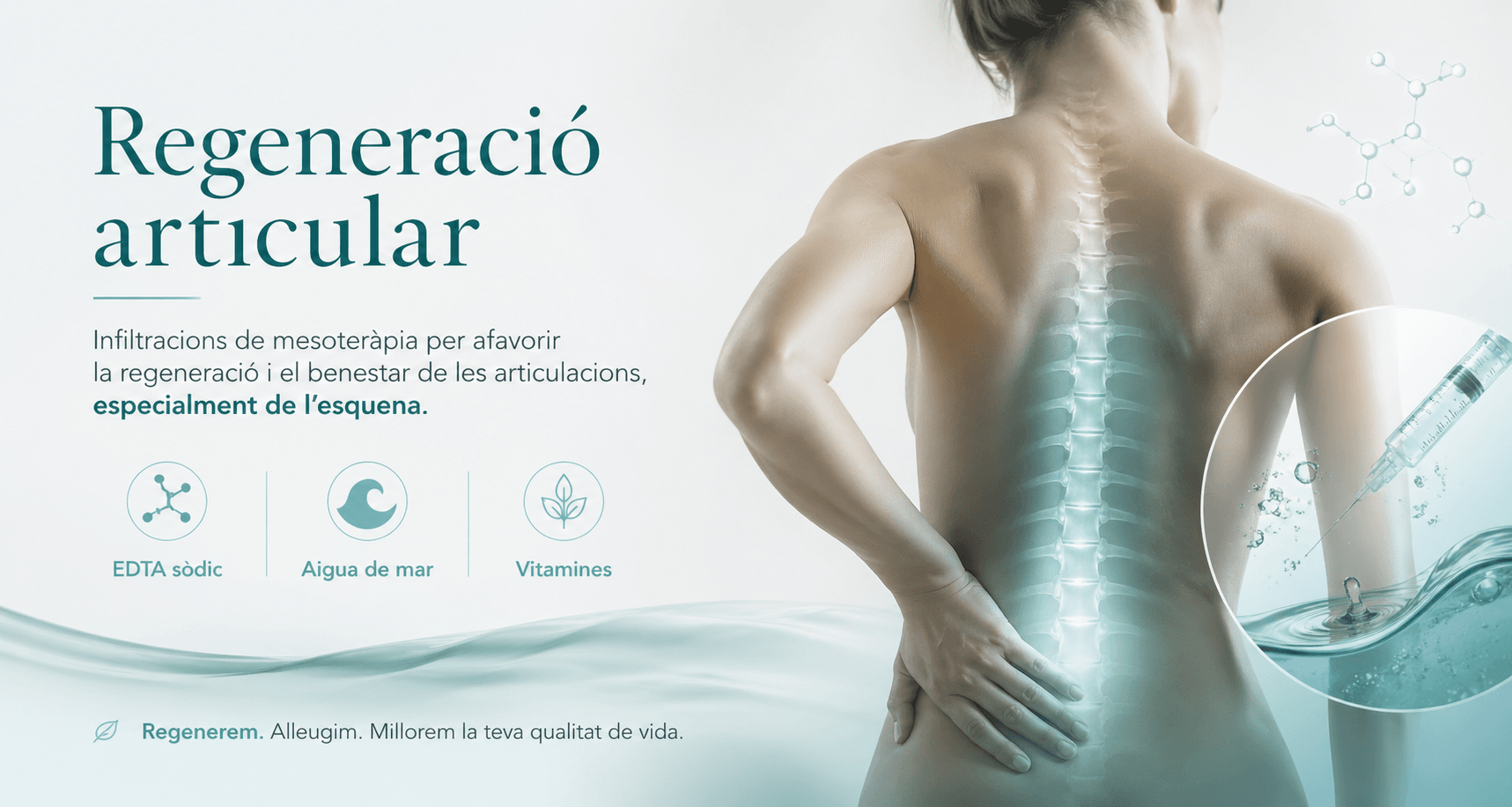
Joint regeneration is a therapeutic approach that goes beyond the symptomatic treatment of pain. Instead of blocking inflammation or reducing painful sensation, it seeks to act on the causes that have led to deterioration: insufficient cellular nutrition, oxidative stress, low-grade chronic inflammation, and the loss of tissue repair capacity.
At Centre Mèdic Dr. Aldosa we apply two main minimally invasive infiltration techniques: Mesochelation and Biopuncture. Both use microinjections of biological, natural or homeopathic substances —never aggressive allopathic drugs— administered locally in the affected area or at specific neuroreflex points.
This approach is part of our global integrative medicine vision: we treat the joint, but also the biological terrain that surrounds it.
Joint regeneration can be a valuable tool in these profiles:
Knee, hip, shoulder or spine, in people who want an alternative or complement to cortisone infiltrations.
Lumbar or cervical, lumbar spinal stenosis.
Persistent lumbago, sciatica, neck pain.
Epicondylitis, plantar fasciitis, rotator cuff tendinopathy, Achilles tendinitis.
Carpal tunnel, cervical and lumbar neuralgias.
With active trigger points.
With cervical and myofascial component.
People who have tried other treatments without sustained results or with side effects.
Who want to accelerate recovery with biocompatible products.
People who want to delay or avoid surgery and prefer treatments with natural products.
Every clinical case is different. That’s why we have two infiltration techniques with complementary mechanisms, which we can use independently or in combination according to needs:
An evolved variant of classical mesotherapy, especially indicated for joint and disc pathology.
Origin and technique. Mesochelation, developed in Nice by Dr. Bernard Guez, starts from the classical mesotherapy of Dr. Michel Pistor but introduces a key innovation: active substances are diluted in significant amounts of sterile saline solution or isotonic seawater. This high dilution creates the so-called "hydrotomy cushion" under the skin, from which the substances progressively distribute towards deeper tissues, including intervertebral discs and joints.
Microinjections with biological and homeopathic substances at neuroreflex points. The most versatile technique for myofascial pain, tendinopathies and mixed conditions.
Origin and technique. Biopuncture was developed by the Belgian doctor Dr. Jan Kersschot, integrating principles from natural medicine, homeopathy and acupuncture. The technique consists of administering microinjections —very small volumes, approximately 0.1-0.3 ml per point— of biocompatible substances at selected points: acupuncture points, myofascial trigger points, or painful and pericicatricial areas.
Unlike Mesochelation, Biopuncture combines the biochemical action of substances with the neuroreflex modulation provided by puncturing selected points. It's a very versatile tool that allows us to personalize the treatment according to the specific clinical picture of each patient.
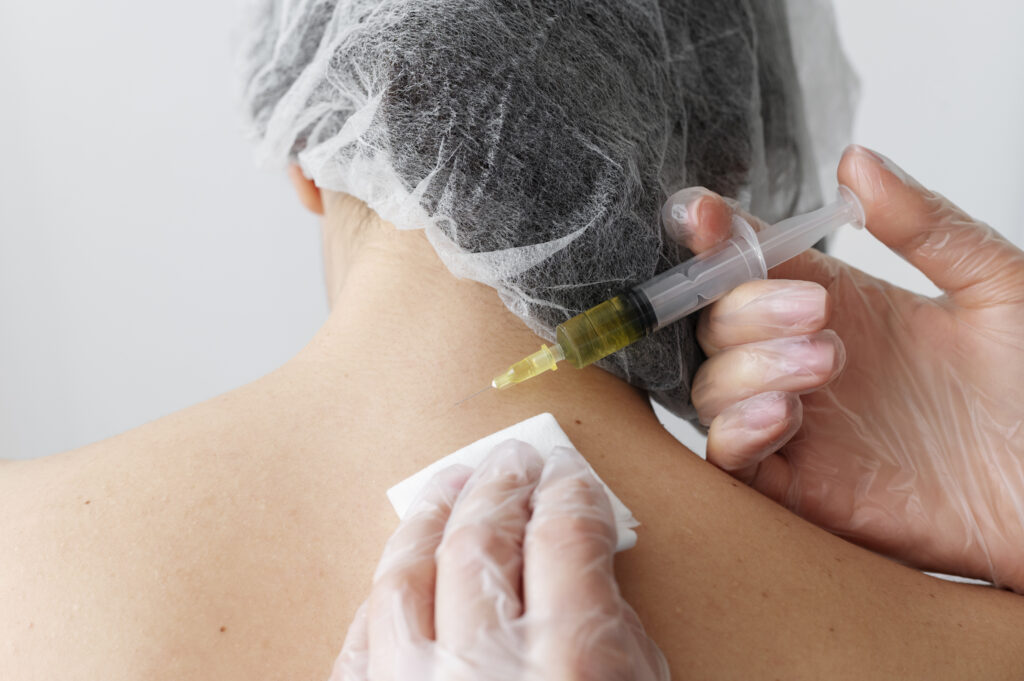
Superficial and intra-articular microinjections performed with fine needles, ensuring minimal discomfort and maximum precision.
Complete history of the problem, physical examination, review of prior imaging tests (MRI, CT, X-rays, ultrasound), identification of contraindications and definition of realistic therapeutic goals. This is a non-negotiable step: we never infiltrate without a proper prior clinical assessment.
Decision on the modality to use (Mesochelation, Biopuncture or a combination of both), selected substances, application points and estimated number of sessions. We explain clearly what we will do, what we won't, and what results are reasonable to expect.
Each session lasts between 10 and 30 minutes. The procedure is generally painless or with minimal discomfort similar to a mosquito bite. It is fully outpatient: you can return to your normal day right after leaving the consultation.
The standard protocol usually starts with a weekly session for 4 to 6 weeks. Afterward, the clinical response is assessed to space out the sessions or move to maintenance.
In chronic degenerative pathologies, maintenance sessions every 4-8 weeks help consolidate regeneration and prevent relapses. Many patients only need 2-4 maintenance sessions per year once stabilized.
These are techniques with a high safety profile, especially compared to corticosteroid or potent anesthetic infiltrations. The products used are natural or of low concentration, and the routes of administration are superficial (subcutaneous, intradermal or periarticular). Even so, like any clinical intervention, it is not suitable for everyone.
The prior clinical assessment always rules out contraindications and adjusts the protocol to your specific case.
Mesochelation and Biopuncture cover different and complementary indications. We can combine them in the same protocol when the case requires it.
Dr. Aldosa Mora brings a long career in infiltrations and integrative medicine that allows adjusting protocols with the judgment only clinical experience can provide.
Joint regeneration is often combined with PNI, ozone therapy, microimmunotherapy or acupuncture depending on the case, within a global therapeutic plan.
Without the side effects of repeated corticosteroids. Patients who have received several previous cortisone infiltrations often find here an alternative that doesn't degrade cartilage.
Each protocol is designed specifically for your case. We don't use one-size-fits-all guidelines.
Joint regeneration integrates naturally within our integrative medicine approach. When the case justifies it, we combine it with:
Intravenous or local ozone enhances the anti-inflammatory effect and tissue regeneration. The far-infrared ozone sauna is an excellent complement for muscle recovery and chronic pain.
Learn more →To regulate underlying inflammation and optimize the biological terrain where the joint problem has arisen.
Learn more →Gentle immune modulation, complementary in chronic and autoimmune pathologies with a joint component.
Learn more →Pain control, muscle relaxation and improved local circulation. A classic synergy with Biopuncture.
Learn more →Cortisone infiltrations are very effective at reducing inflammation and pain in the short term, but over time they can degrade joint cartilage and lose effectiveness. Mesochelation and Biopuncture seek the opposite: to provide elements that help tissue regeneration, without accumulated degradation. They are not mutually exclusive: there are cases where a one-off cortisone infiltration is the best short-term option, and others where our techniques are more appropriate in the long term. The clinical decision is made case by case.
It is a generally painless treatment. The needles we use are very fine and the substances are administered in very small volumes. Most patients only notice a slight discomfort similar to a mosquito bite at the moment of injection. When necessary, we can add a minimal amount of diluted procaine to make the session even more comfortable.
It depends on the problem and the evolution of each case. The standard protocol usually begins with a weekly session for 4 to 6 weeks to consolidate the response. Afterwards we assess whether spaced maintenance sessions are needed. In acute pathologies (for example, a recent tendinitis), 2-3 sessions may be enough. In chronic degenerative pathologies (advanced osteoarthritis), it can be a longer process with periodic maintenance.
Many patients notice improvement already after the first or second session, especially in painful conditions with inflammatory or myofascial component. In more established degenerative pathologies (advanced osteoarthritis, chronic herniations), results usually become evident between the fourth and sixth session. Tissue regeneration is a gradual process: sustained improvement appears over time.
Yes. It is an outpatient treatment and most people return to their daily life immediately. We recommend avoiding intense physical exercise for the first 24 hours and maintaining good hydration. Some people may notice slight local discomfort for 24-48 hours, but without limiting their usual activities.
No. This is a private treatment and is not covered by CASS.
In the vast majority of cases, yes. These techniques are compatible with most medications and treatments. There are some exceptions we assess in the initial consultation (high-dose anticoagulants, severe immunosuppression). In no case will we ask you to abandon a treatment prescribed by your doctor without prior coordination with the prescriber.
It can help, but it is important to have realistic expectations. Complete regeneration of a joint with advanced osteoarthritis is not possible with any conservative technique. What we can often achieve is to significantly reduce pain, improve mobility, slow progression and, in some cases, postpone or avoid surgery. In the first consultation we assess the degree of osteoarthritis and give you a realistic estimate of what we can expect.
In some cases yes, especially when treatment starts in early or intermediate phases. There are patients who are on a surgical waiting list and, after a cycle of joint regeneration, decide to postpone the intervention indefinitely. But this is not the case in all advanced osteoarthritis: there are situations where surgery is the best option, and we say so clearly when that’s the case. Our job is to assess your case honestly, not to sell treatments without indication.
The cost depends on the modality, the complexity of the case and the number of sessions planned. We offer you a first assessment where, after studying your case, we detail the proposed protocol with the total cost. You can request price information by phone (+376 867 700) or via the contact form indicating the reason for the consultation.
If you live with joint pain, a disc herniation or a tendinopathy that hasn’t resolved, the first step is a clinical assessment to decide whether joint regeneration makes sense in your case and, if so, with which modality and protocol.
Av. Carlemany 75, 2nd floor 1st door
AD700 Escaldes-Engordany · Andorra
Monday to Friday
9:00 — 13:30
Saturdays and Sundays closed